
Blog, Disease & Pest Prevention, Emergency Tree Care, Home Gardening Tips, Home Tree Care
The Hidden Dangers of Tree Cavities: What That Hole in Your Tree Could Mean
You notice a hole in the trunk of one of your trees. Maybe it’s small. Maybe you can see straight into the tree. Maybe you’ve lived with it for years and never thought much about it.
So, is the tree dangerous?
A tree cavity can be a warning sign of internal decay or structural problems, but its presence doesn’t automatically mean a tree needs to be removed. Understanding what causes cavities, and what they can tell you about a tree’s health and stability, is an important part of responsible tree care.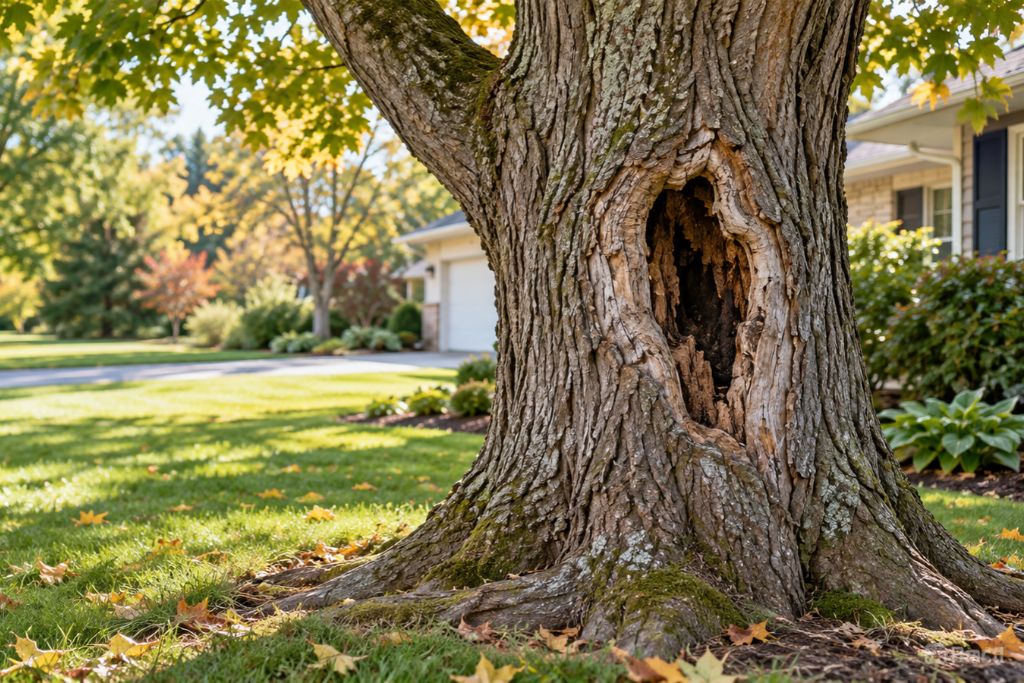
And sometimes, what you can’t see is more important than what you can.
What Causes a Tree Cavity?
Tree cavities typically develop after some form of injury or damage to the tree. A broken branch, storm damage, pruning wound, insect activity, disease, or damage to the trunk can create an opening where decay organisms gain access to the wood.
Trees don’t heal wounds in quite the same way people do. Instead, they compartmentalize damage, creating boundaries around injured or decaying areas and continuing to grow new wood around the affected section.
When decay progresses faster than the tree can contain it, a cavity may develop.
The result can be anything from a small hollow area beneath an old branch stub to a substantial opening extending deep into the trunk.
Is a Hollow Tree Automatically Dangerous?
Not necessarily.
This is one of the biggest misconceptions about tree cavities.
A tree can have a cavity and remain structurally stable. Conversely, a tree can have significant internal decay without showing an obvious cavity on the outside.
That’s why simply looking at the size of a hole doesn’t tell the whole story.
An arborist evaluating a tree will consider factors such as the location and size of the cavity, the amount of sound wood remaining, the tree’s overall condition, its root system, its structure, and what surrounds it.
A tree standing in the middle of a large, open field presents a very different level of concern than the same tree leaning over a house, driveway, playground, or heavily used walkway.
Location matters.
What Should You Look For?
While homeowners can’t diagnose structural problems simply by looking at a tree, there are signs that deserve professional attention.
Watch for:
- Large cavities or openings in the trunk
- Visible decay or soft, deteriorating wood
- Mushrooms or fungal growth on or around the trunk
- Cracks or splits in major limbs or the trunk
- Dead or declining branches
- Significant changes in the tree’s canopy
- Leaning that appears to have developed or worsened
- Previous storm or mechanical damage
None of these signs, by themselves, necessarily mean the tree must come down.
They do mean it’s worth taking a closer look. And in many cases, an assessment from a certified arborist is a wise decision.
The Problem with Looking Only at the Hole
A cavity is often just the visible portion of a much larger story.
Decay can extend beyond what you can see from the outside. It may affect a portion of the trunk, a major branch, or even areas near the tree’s base.
Roots matter, too.
A tree with a seemingly modest cavity but significant root damage may present a different structural concern than a tree with a larger cavity and an otherwise strong root system.
This is why tree risk assessment involves more than measuring the hole and deciding whether it looks “big enough” to worry about.
Trees are complicated organisms.
Fortunately, that’s what arborists are trained to understand.
Can a Tree With a Cavity Be Saved?
Sometimes.
The appropriate response depends on the cause and extent of the problem, the tree’s species and condition, its structural stability, and the potential consequences if part or all of the tree were to fail.
In some cases, appropriate pruning or other tree-care practices may help reduce risk and improve the tree’s condition. In other situations, monitoring may be appropriate.
And sometimes removal is the responsible choice.
The important thing is not to make that decision based solely on appearances.
A professional tree assessment can help determine what is happening inside and around the tree and what options may be available.
Why Timing Matters
A tree cavity isn’t necessarily an emergency simply because you discovered it.
But if the tree is located near a home, business, power line, road, driveway, or other area where a falling branch or tree could cause significant damage or injury, it’s worth having the situation evaluated sooner rather than later.
This is particularly important before periods of severe weather.
Heavy wind, snow, and ice can place additional loads on branches and tree structures that may already be compromised by decay or damage.
A tree that has been standing quietly for years can face very different conditions when Mother Nature adds several hundred pounds of ice to its branches.
Don’t Make the Diagnosis from the Driveway
A cavity can be a warning sign. It can also be one small part of a much larger picture.
The right question isn’t simply, “How big is the hole?”
It’s “What does the hole tell us about the condition and stability of the tree?”
At Hansen’s Tree Service, our tree-care professionals can evaluate trees showing signs of decay, cavities, structural problems, or other concerns and help property owners understand their options.
If you’ve noticed a cavity in one of your trees, don’t panic and don’t ignore it.
Have it evaluated. Know what you’re dealing with. And make decisions based on the tree, not the hole. Questions? Contact us today; we’re here to help!